
Blog title heading will go here


swissdamed Readiness 2026: What MedTech Companies Need to Know - and How to Prepare
Switzerland is often treated as “EU-adjacent.” That is understandable: Swissdamed follows many of the same UDI concepts as EUDAMED, and existing EUDAMED data can provide a strong starting point.
But alignment is not integration. Switzerland has its own regulatory framework, authority, database and submission track. The practical task is to reuse what can be reused while making Swiss-specific differences visible, owned and manageable.
What “swissdamed-ready” really means
Readiness is not simply identifying products or preparing an XML file. A ready organisation knows:
- which products and actors are in scope
- who owns the relevant data and decisions
- what can be reused from existing UDI and EUDAMED processes
- which Swiss-specific data and relationships must be mapped or added
- who prepares, reviews, submits and maintains the data.
The submission is only the visible part. Readiness depends on the operating model behind it: clear ownership, controlled mapping, validation before submission, documented responsibilities and a process for handling changes after publication.
The goal is not a second, disconnected data universe for Switzerland. It is one governed foundation with a clearly managed Swiss extension.
Why preparation cannot wait
swissdamed has moved into operational use in stages:
- The Actors module has been in operation since August 2024.
- The Devices module has been available since August 2025.
- Since 1 July 2026, devices, systems and procedure packs placed on the Swiss market are subject to mandatory registration.
- The transition period runs until 31 December 2026.
The transition period should be used to reduce backlog, validate the submission process and establish update routines. Even while some technical details evolve, organisations can already assess their portfolio, actor relationships, data ownership, source systems and approval processes.
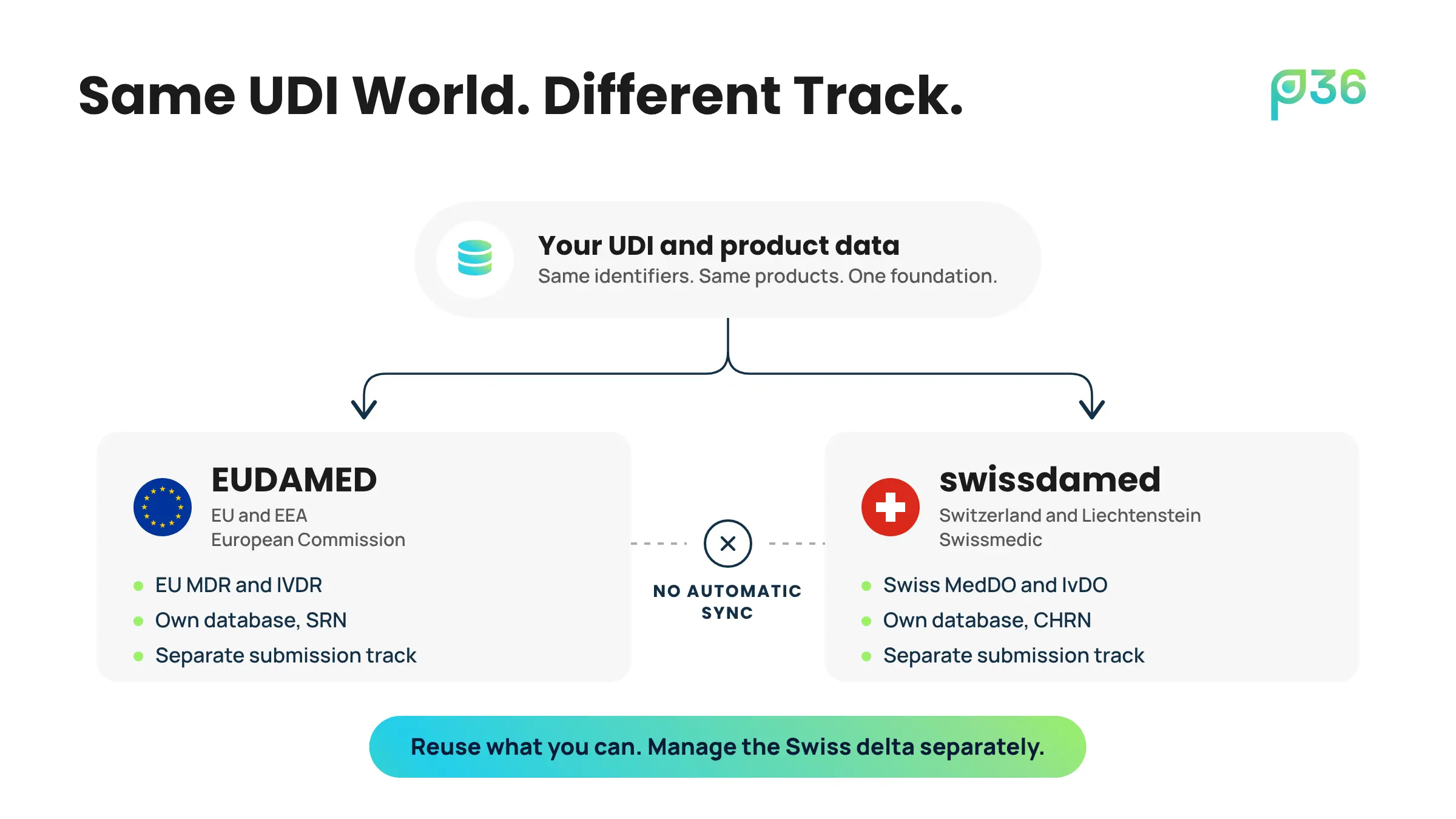
swissdamed and EUDAMED: same UDI world, different track
swissdamed Readiness: Same UDI World. Different Track. © p36 GmbH
Both systems use structured UDI and device data, but they operate under different frameworks and authorities:
- EUDAMED covers the EU and EEA and is managed by the European Commission.
- swissdamed covers Switzerland and Liechtenstein and is operated by Swissmedic.
The systems are not automatically synchronised. An EUDAMED registration does not constitute a Swiss registration, and changes made in one database do not automatically update the other.
The right approach is therefore neither “start from scratch” nor “copy everything across.” It is controlled reuse.
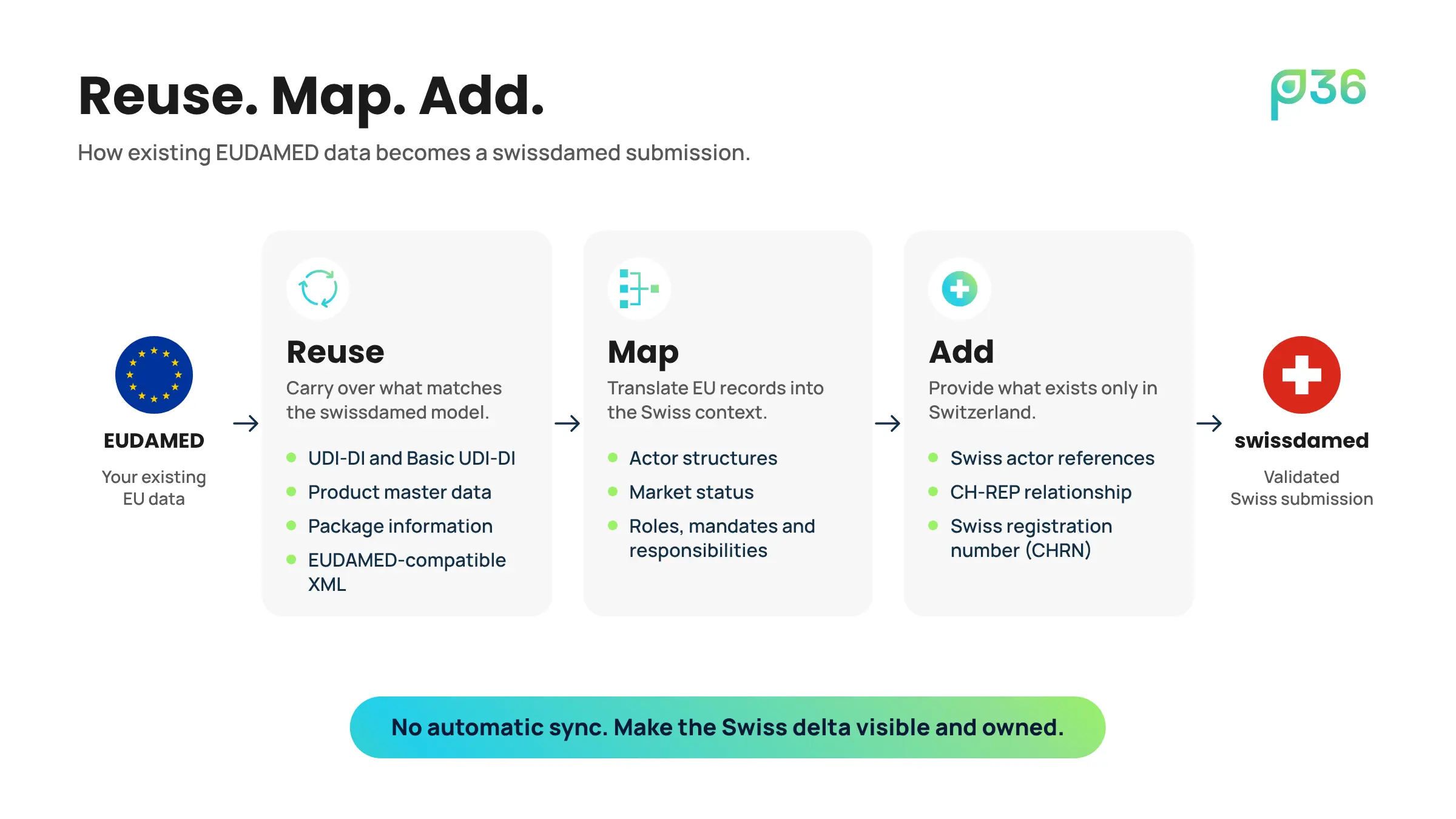
Reuse, map and add
Existing EUDAMED work may provide a strong foundation, including Basic UDI-DI and UDI-DI information, device and product master data, package information and established ownership or validation processes.
Swissdamed supports XML-based data exchange, and EUDAMED-compatible data can be reused where it matches the Swissdamed model. However, data still needs to be mapped, validated and submitted through the Swiss process.
A practical way to manage the Swiss delta is:
swissdamed Readiness: Reuse. Map. Add. © p36 GmbH
This model makes the Swiss delta visible and helps assign ownership.
Actors, CH-REP and submission ownership
Responsibilities are a frequent source of rework. For a Swiss manufacturer, the registered manufacturer may submit the relevant device data. For a non-Swiss manufacturer, the CH-REP submits devices covered by its mandate.
The CH-REP does not therefore become the owner of the manufacturer’s product data:
- The manufacturer provides, maintains and approves the underlying product and regulatory data.
- The Swiss registrant submits the device data.
- The CH-REP fulfils its Swiss representation and registration responsibilities.
- The submitter or CH-REP coordinates responses to Swissmedic or system feedback.
The exact setup depends on the organisation’s role, portfolio and Swiss market arrangements. The key point is that responsibilities, handoffs, approvals and evidence should be agreed before implementation is scaled — not left in a contract or an informal understanding.
Known, unknown; and still actionable
Organisations may hesitate while technical specifications, interfaces or detailed validation rules continue to develop. A more practical approach is to separate preparation from monitoring.
Act now
- Establish the separate Swiss regulatory and database track.
- Confirm actor relationships and submission responsibilities.
- Assess existing UDI and product data.
- Identify Swiss-specific differences.
- Define data ownership, validation and change handling.
Keep monitoring
- technical specifications and validation rules;
- interface and release developments;
- product-specific requirements and business logic;
- transition and operational details that may be clarified over time.
Do not wait for perfect certainty. Build a stable core, isolate the Swiss-specific elements and maintain an owned watchlist for changes.
A practical preparation plan
Now
- Identify products already placed, or soon to be placed, on the Swiss market.
- Confirm actors, CH-REP relationships and registration status.
- Identify current UDI and EUDAMED data sources.
- Assign owners for product data, actors, approvals and regulatory monitoring.
- Select a representative product sample.
Next
- Compare existing records with swissdamed requirements.
- Classify information as reusable, mappable or new.
- Identify data gaps and relationships.
- Agree who prepares, reviews, approves and submits the data.
- Define validation, error handling and evidence requirements.
Later
- Validate and submit the remaining portfolio.
- Establish update and re-validation routines.
- Track submission outcomes and recurring data issues.
- Maintain a record of who changed what, when and why.
- Assess automation or machine-to-machine options where manual effort becomes costly.
A representative product sample often exposes structural issues earlier than a broad but shallow review.
Three situations that create rework
An EUDAMED-ready portfolio: Existing data is a valuable asset, but not a complete Swiss submission. Validate the mapping, confirm Swiss actor relationships and establish the separate process.
Swiss-only products: These may not fit neatly into an existing EUDAMED implementation. Assess the approach at portfolio level, including products that may be introduced in Switzerland later.
A data gap or missing owner: A missing field is often manageable. A missing owner is more difficult. Without accountability, gaps may remain unresolved, reappear in several records or delay submission.
Your swissdamed readiness check
Use these questions to assess your position:
- Is our Swiss product portfolio clearly defined?
- Are actors and CH-REP responsibilities confirmed?
- Who owns the product, actor and submission data?
- Which EUDAMED data can be reused?
- Are Swiss-specific gaps and mappings documented?
- Is the approval and submission process agreed?
- Are credentials, validation and technical dependencies understood?
- Do we have a process for updates, errors and evidence?
- Is someone monitoring open regulatory and technical points?
Our swissdamed Readiness Checklist provides a structured way to run this assessment across your portfolio.
Final thoughts
swissdamed readiness is not about creating a separate process for every market or waiting until every detail is final. It is about making the difference between the EU and Swiss tracks explicit and manageable.
The organisations best positioned to avoid rework will reuse existing UDI and EUDAMED data where appropriate, isolate Swiss-specific requirements, clarify actor and CH-REP responsibilities early, validate a representative sample and maintain an owned watchlist for evolving requirements.
The practical objective is simple: one trusted data foundation, a clearly managed Swiss delta and an operating model that can adapt as requirements develop.