
Blog title heading will go here


EUDAMED Readiness 2026:
What You Need to Have Under Control Before You Submit
Most MedTech teams know the EUDAMED timeline. The harder question is what "ready" actually means once you sit down to submit. In my day-to-day work supporting manufacturers with UDI and EUDAMED, I see the same pattern again and again: teams that look ready on paper still hit friction at submission — not because they missed the deadline, but because the data and processes behind the fields weren't under control.This article walks through what operational EUDAMED readiness really looks like, the six places where submissions actually break, and a practical way to get — and stay — ready.
What "EUDAMED-ready" really means
Here's the test I'd ask any team to apply: Would you feel comfortable defending this submission in front of an auditor?
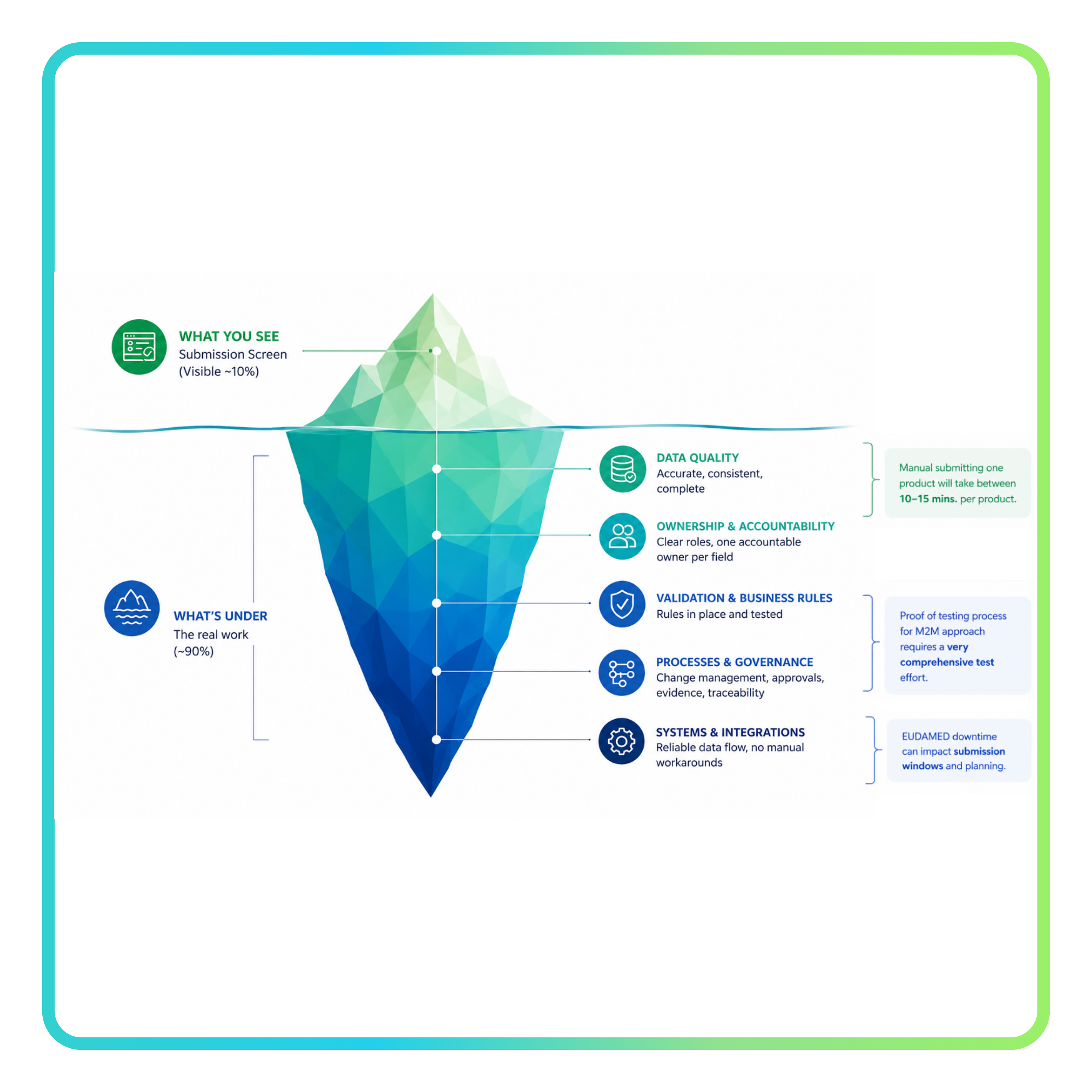
If the honest answer is "not sure," then "ready" hasn't been reached yet — no matter how complete the screen looks. EUDAMED readiness isn't a filled-in form. It's a controlled state where your data is correct, consistent, owned, and defensible over time.The trap is treating EUDAMED as "just filling in fields." The fields are the visible 10%. The 90% that decides success is the data and process behind them.
Critical deadlines for EUDAMED compliance
The European Commission has set two pivotal milestones:
- May 28, 2026: Mandatory registration of Basic UDI-DI and UDI-DI for newly launched devices.
- Nov 28, 2026: Full compliance for all devices already placed on the EU market, including legacy devices under transitional provisions.
Two waves, two timings — but the operational discipline is identical for both: clear scope, clean data, and validation before submission. Plan for both from the start, so legacy devices don't become a last-minute scramble.
What actually goes wrong
When submissions run into trouble, the root causes are rarely "EUDAMED problems." They're internal readiness gaps that EUDAMED simply makes visible — and public:
- Inconsistent or contradictory master data
- Unclear ownership ("who is responsible for this field?")
- Missing or weak validation logic
- Update chaos when data changes after submission
- EUDAMED doesn't create these problems. It exposes them.
The 6 failure modes: where submissions actually break
Across real projects, six patterns accout for most of the pain:
1. Scope & Classification Gaps
You can't be ready for a scope you haven't defined. The usual blind spots: legacy devices, procedure packs and systems, product variants, and configurable devices. Start by knowing exactly which products belong in EUDAMED.
2. Basic UDI-DI logic done wrong
Basic UDI-DI is a grouping decision, not a code you generate. Common mistakes — one Basic UDI-DI per product, wrong grouping across variants, packaging levels treated as new products, or product changes triggering unnecessary new Basic UDI-DIs — all poison everything downstream. Get the grouping principle right first, then apply it consistently.
3. Missing or Contradictory Master Data
Which system do you actually trust? ERP-versus-PLM inconsistencies, competing spreadsheet versions, multilingual fields, unit-of-measure mismatches, and supplier data that was never reconciled all surface here. You need one authoritative source, not several that disagree.
4. No Validation Before Submission
Every rejection is a round trip. Cross-field inconsistencies, conditional ("required-if") fields, missing business-rule validation, and manual-only checks are the typical culprits. Validate before you submit — not after EUDAMED sends it back.
5. Update & Change Chaos
Submission is not the finish line. After go-live, who keeps EUDAMED up to date? Without a defined change owner, product changes don't get reflected, re-validation is skipped, and a single change can quietly affect multiple records. The steady state is the real challenge.
6. No Evidence or Traceability
Can you prove your data is correct tomorrow? If an auditor asks for the history of one field months later, you need to show who changed what, when, and why. Without audit-ready logs, "trust us, it's correct" isn't enough.
The Target State: a UDI "Control Tower"
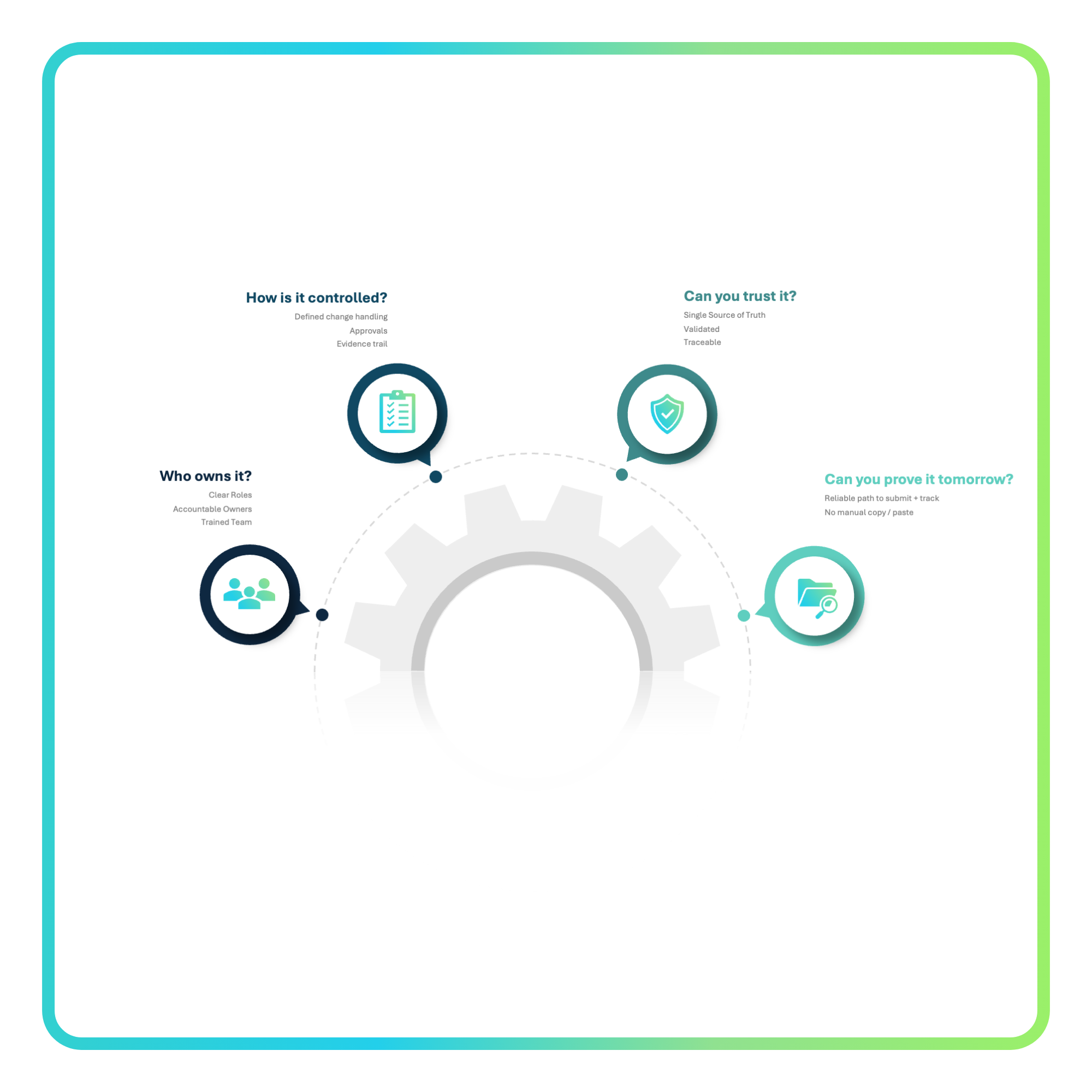
The teams that struggle least don't treat readiness as a one-off data-entry task. They run it as an operating model — a control tower with four things always in view:
Own it — clear roles, accountable owners, a trained team.
Govern it — defined change handling, approvals, an evidence trail.
Trust it — a single source of truth: validated and traceable.
Prove it — a reliable path to submit and track, with no manual copy/paste.
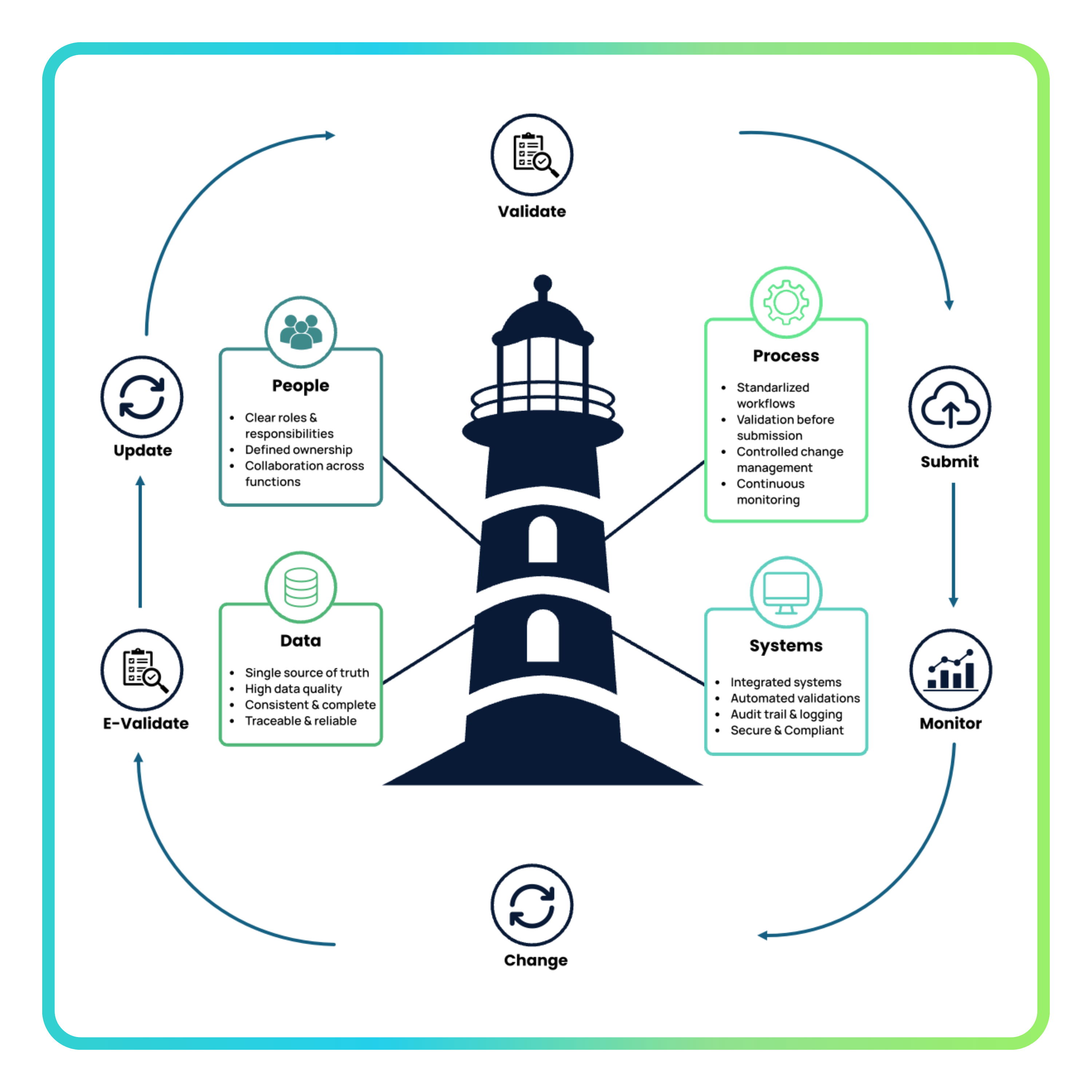
Readiness is not a project you finish. It's an operating model you run.
That model only works when ownership is shared and explicit. In practice: RA/QA owns regulatory interpretation and accountability, Master Data owns data quality and the single source of truth, and IT owns the systems and submission path. Make the RACI clear, so no field is ever "someone else's problem."
From Practice
SUBAN faced EUDAMED registration for several thousand devices, previously maintained by hand in spreadsheets. Moving from field-by-field entry to a structured, validated, direct submission turned a slow, error-prone process into a scalable one — a clear reminder that structure and validation, not more manual effort, are what make volume manageable.
Raumedic approached readiness as governance and data control rather than data entry — the difference that lets a team stay audit-ready as requirements evolve, instead of scrambling each time something changes.
Next Steps: Take Action Today
Step 1: Download our practical EUDAMED Readiness Checklist and run it against your own portfolio this week — across people, process, data, and systems.
Step 2: Want to pressure-test your own situation? Book a free 30-minute Readiness Session with one of our UDI experts and bring your hardest edge case.
Final Thoughts
EUDAMED compliance is demanding, but it doesn't have to be chaotic. The teams that get there calmly are the ones who stop thinking in fields and start thinking in operating models: clear ownership, one trusted source of data, validation before submission, and traceability you can defend. Get those under control, and "ready" stops being a guess — it becomes something you can prove.
Further reading & sources
EUDAMED overview — European Commission: https://health.ec.europa.eu/medical-devices-eudamed/overview_en
EU UDI Helpdesk:
https://webgate.ec.europa.eu/udi-helpdesk/en/welcome-to-eu-udi-helpdesk.html
EUDAMED Readiness Webinar: https://www.gotostage.com/channel/d8a19580486f4290a34b3da678824e4c
